A pattern becomes an instruction
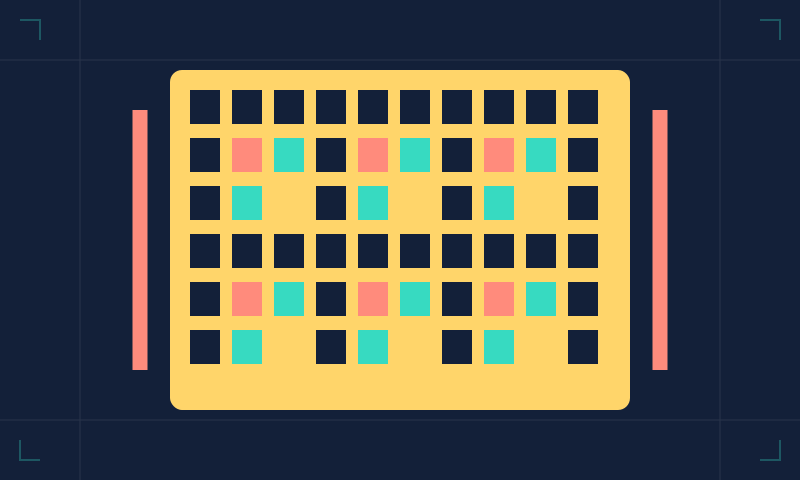
A woven pattern is a sequence of decisions: which threads should lift, and which should stay down? The Jacquard mechanism, developed in France in 1804–1805, turned those decisions into holes in linked cards. Where a hole let a pin pass, part of the mechanism could move; elsewhere, the card stopped it. The result controlled the warp threads as the weft crossed them. It was a way to repeat a complicated design without asking a person to remember every separate instruction.
An object, not an origin myth
The Science Museum Group’s particular hand loom is a teaching example made around 1910. That date matters: a surviving object is not automatically the first version of an invention. Nor was the Jacquard loom a modern general-purpose computer. It performed a specific job. Its interesting connection to computing is the separation of instructions from the mechanism carrying them out. Changing a sequence of cards changed the pattern while leaving the basic machine intact.
Try thinking in rows
Draw a grid eight squares wide and eight high. Mark some squares to make a simple letter. Each row is now one instruction: lift, leave, lift, leave. Write the row as eight ones and zeroes, using one for a marked square. Give those eight lines to someone who has not seen your picture, together with the rule. If they rebuild the image, you have transmitted a pattern as instructions. Our Pixel Studio lets you try the same idea without needing a loom.
The useful question
This is not a claim that weaving and software are identical. Real cloth has tension, material behaviour and a direction in which it is made; an on-screen grid does not. The comparison becomes useful when you ask what is fixed and what can change. The frame, the lifting mechanism and the rules stay fixed. The pattern changes. Look for that division in a music box, a knitting chart or a recipe: somewhere there is a system, and somewhere there are instructions that let the system produce a different result.
A small project to keep
Make a second grid with a different letter, then combine the two instruction lists. Swap one row deliberately and see whether your partner can spot the mistake. Keep the original next to the reconstructed version. It is a surprisingly clear way to see why a readable instruction format, a known starting point and a way to check errors all matter. You do not need to call it programming to enjoy the moment a little picture survives a journey through numbers.
TAKE ANOTHER BYTE
Make an eight-by-eight pictureSources & further reading
References support the historical or technical facts. Paper exercises and comparisons are our own explanatory activities.
Researched and written with AI assistance, edited for the Really Byte collection. Spotted an error? Tell us. Read our editorial approach.