A machine survives in pieces
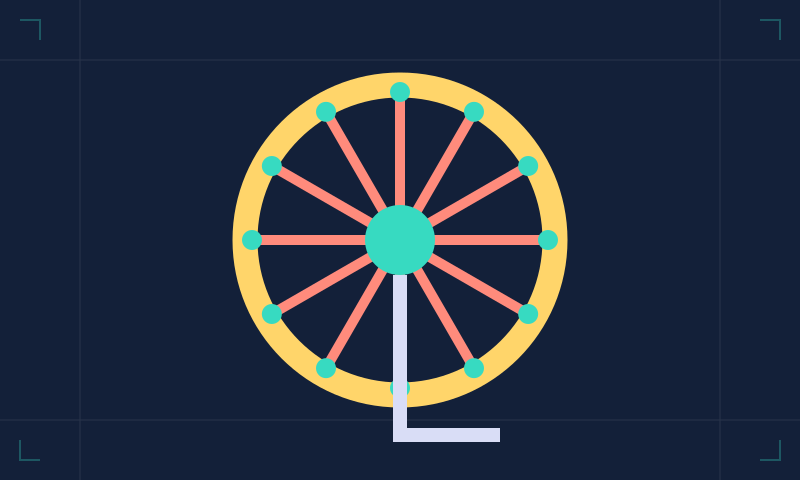
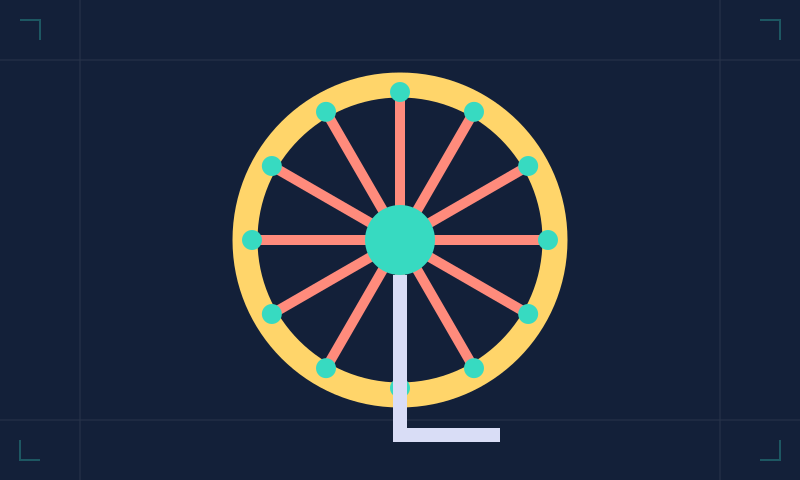
The Antikythera mechanism is an ancient Greek astronomical calculator. What survives is fragmented: the National Archaeological Museum describes 82 fragments and about a third of the original device, with 30 surviving bronze gears. That combination is extraordinary, but it also sets the limits of the story. A photograph of the remains, a drawing of a proposed complete mechanism and a working modern model are three different kinds of evidence.
Calendars have awkward rhythms
Days, lunar months and years do not fit together as a neat set of identical boxes. A mechanism can represent relationships between those cycles through gearing. The surviving device includes evidence relating to eclipse cycles, including the Saros and Exeligmos. That does not mean it was a modern observatory in a box, or that every lost detail is settled. The remarkable achievement is a physical arrangement of mathematical relationships that people could consult.
What a reconstruction means
Researchers combine surviving parts, inscriptions, imaging and mathematical constraints to propose how missing sections might have worked. The linked UCL paper presents a model, not a newly recovered intact ancient machine. A reconstruction is strongest when it explains the evidence without requiring arbitrary extra parts. Different proposals can be informative even while a question remains open. It is entirely possible to admire the engineering and still say ‘this part is uncertain’.
Try a ratio without a workshop
Draw two circles on paper. Give the first eight equally spaced marks and the second sixteen. Imagine one mark passing a fixed pointer each time the first circle turns an eighth of a revolution. A wheel with twice as many teeth takes longer to complete a turn when driven by the same tooth-by-tooth movement. You are not recreating the Antikythera mechanism, but you are exploring the basic reason a gear train can express a numerical relationship.
A better museum question
Instead of asking only ‘how old is it?’, ask which part of the interpretation comes from the object itself. What can be counted? What is written? What has been inferred from a missing section? Those questions make the device more interesting, not less. They let us see both the skill of its ancient makers and the patient work of the people studying damaged evidence now. Wonder does not need a fully solved mystery to keep going.
TAKE ANOTHER BYTE
Explore books and mechanical puzzlesSources & further reading
References support the historical or technical facts. Paper exercises and comparisons are our own explanatory activities.
Researched and written with AI assistance, edited for the Really Byte collection. Spotted an error? Tell us. Read our editorial approach.